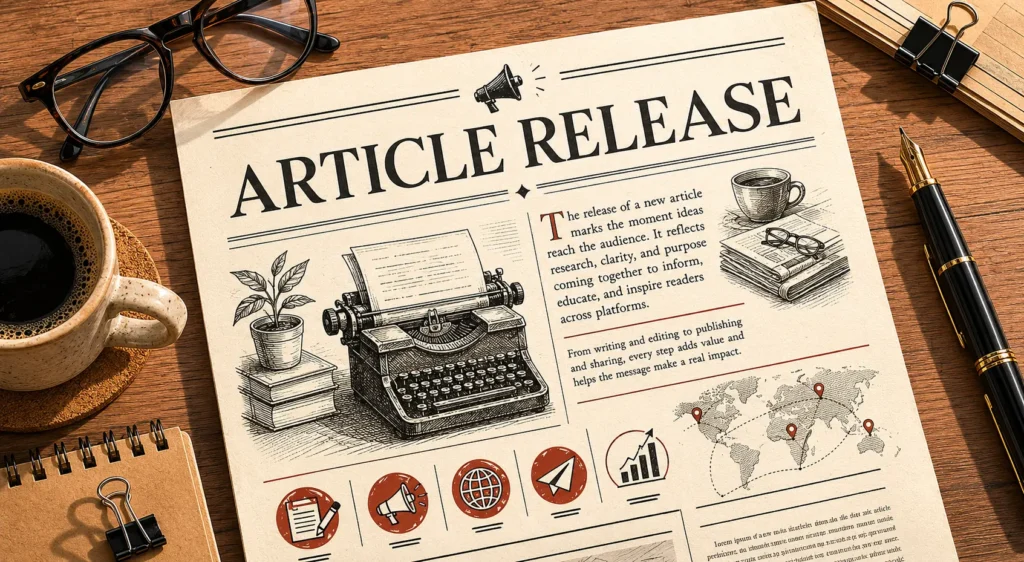
Articlerelease is the strategic process of preparing, optimizing, timing, and distributing written content so it reaches the right audience. It goes far beyond pressing “publish.” A successful articlerelease combines on-page SEO, smart platform selection, and post-release promotion. When done correctly, it builds topical authority, improves search visibility, and drives compounding traffic over time.
Most writers spend 90% of their time writing and only 10% thinking about the release. But here is the truth: your publishing strategy decides whether anyone actually reads your work. A great article with a poor release plan disappears. A good article with a strong articlerelease strategy builds traffic, earns backlinks, and gets cited by AI engines. This guide breaks down exactly what articlerelease means, why it matters more than ever in 2026, and how to execute one step by step.
What Is Articlerelease?
Articlerelease is the complete cycle of preparing, publishing, and distributing a written piece of content so it performs well across search engines, social platforms, and AI-powered tools. It is not just the moment you click “publish.” It includes everything that happens before and after that click.
Think of it this way. Writing the article is building the product. The articlerelease is launching it. Without a proper launch, even the best product sits on a shelf unseen.
Key attributes of articlerelease include:
- Strategic keyword placement and on-page SEO before publishing
- Timed publication based on audience behavior data
- Multi-channel distribution after the article goes live
- Ongoing performance tracking to refine future releases
Millions of blog posts are published every single day. Without a structured editorial strategy behind your content publishing process, your article is competing against a flood of content with no visibility plan.
Why Articlerelease Matters More in 2026

Has Publishing an Article Always Needed a Strategy?
No. A few years ago, publishing consistently was often enough to grow traffic. Today, the rules have changed completely. Google’s AI Overviews now occupy the top section of many search results pages, pushing traditional organic results further down. Generative engines like ChatGPT, Perplexity, and Gemini now answer user questions directly by pulling from structured, well-released content.
This means your article needs to be formatted and released in a way that both search engines and AI engines can understand, extract, and cite.
The concept of recognition has replaced the old goal of just ranking. According to Search Engine Land, SEO in 2026 is about getting your content recognized and cited, not just indexed. Content saturation is real. Millions of articles compete for the same eyeballs. A smart articlerelease is what separates content that fades from content that compounds in value over time.
Two things now define digital content release success:
- Structured formatting so AI engines can extract and cite your content as a trusted source
- Active distribution so human readers find it before it gets buried in the noise
The 5 Core Elements of a Successful Articlerelease
A strong articlerelease does not happen by accident. It follows a repeatable framework. Here are the five core elements every content publishing process must include.

1. Content Preparation
Before writing a single word, understand your target audience and search intent. Research the keyword you are targeting. Map out the structure with clear H2 and H3 subheadings. Plan internal links to related pages. Content that starts with preparation performs better from day one.
2. On-Page Optimization
Once written, your article needs proper optimization before it goes live. This means placing your target keyword in the title tag, URL slug, meta description, and naturally within the first 100 words. Add internal links to related content. Compress images. Add schema markup so search engines understand your content structure.
Tools like Yoast SEO and RankMath guide you through this process inside WordPress with actionable readability and SEO checks.
3. Pre-Publish Review
Never skip this step. Review for spelling errors, broken links, missing alt text, and formatting issues. If possible, have a second person review the article. Check how it looks on mobile. A polished article signals quality to both readers and search engines.
4. Publication Timing
When you publish matters. Analyze your audience behavior data in Google Analytics to find when your readers are most active. Publishing at peak activity hours generates faster initial engagement signals, which tells Google your content is relevant and timely.
5. Distribution Activation
This is the step most bloggers skip. Distribution is where the content publishing process transforms into a true articlerelease. Share across relevant channels, submit the URL to Google Search Console for fast indexing, and send it to your email list. We cover this in full in the distribution section below.
How to Execute an Articlerelease Step by Step
Knowing the five elements is one thing. Executing them in the right order is what makes the difference.
What Should You Do Before Publishing?
Before publishing, complete these steps in order:
- Finalize keyword placement in the title, first paragraph, and at least two subheadings
- Write a compelling meta description under 160 characters that includes your target keyword
- Set a clean, keyword-rich URL slug
- Add internal links to at least two related pages on your site
- Add schema markup (Article or BlogPosting type) to help search engines classify your content
- Compress all images and add descriptive alt text
- Run a final Yoast readability check and aim for a green score
What Should You Do Immediately After Publishing?
Post-publish actions determine how fast your articlerelease gains momentum:
- Submit the new URL in Google Search Console under “URL Inspection” to trigger fast crawling
- Share on LinkedIn, X (Twitter), or relevant niche communities with a tailored message per platform
- Send to your email newsletter list within 24 hours of publication
- Update any older related articles on your site with a contextual internal link pointing to the new post
- Monitor Google Search Console impressions and clicks at the 7-day mark
These steps are not optional extras. They are the core of what separates a strategic articlerelease from a passive publish-and-wait approach.
Choosing the Right Distribution Channels for Your Articlerelease

Where you release your article shapes how far it travels. Not all channels work the same way. Blindly cross-posting the same content everywhere is not a distribution strategy. It is noise.
Here is a simple breakdown of how each channel serves your blog article release timing and reach:
| Channel | Best For | Effort Level | Expected Outcome |
| Your Blog (SEO) | Long-term organic search traffic | Low (already done) | Compounding traffic over 3-6 months |
| Google Search Console | Fast indexing | Very Low | Crawled within hours |
| Email Newsletter | Loyal audience reach | Low-Medium | Immediate clicks from warm readers |
| Professional and B2B audiences | Medium | Engagement and referral traffic | |
| Content Syndication (Medium, Flipboard) | Broader content discovery | Medium | New audience exposure |
| Social Media (Niche Communities) | Community engagement | Medium | Fast early traffic signals |
Tailor your message to each platform. A full 2,000-word article becomes a short insight post on LinkedIn. It becomes a one-paragraph teaser in your email. Repurposing content across channels also increases the chances that AI engines encounter your content in multiple contexts, which strengthens citation probability.
Articlerelease and SEO: What Is the Connection?
Articlerelease and SEO are not separate activities. They are two sides of the same process. The release process directly determines how well your article gets crawled, indexed, and ranked in Google.
Here is a focused SEO checklist for your articlerelease:
- Place your primary keyword in the page title, URL slug, and meta description
- Include your keyword naturally in the introduction within the first 100 words
- Use related LSI keywords and semantic keywords throughout the body to signal topical authority
- Link to at least two internal pages with descriptive anchor text
- Add a canonical URL to avoid duplicate content issues if syndicating
- Include schema markup (BlogPosting or Article) for enhanced SERP features
Modern SEO is not about stuffing keywords. Search engines like Google reward content that genuinely answers user questions with clarity and depth. Your articlerelease should be built around search intent first. The technical SEO layer supports that intent, it does not replace it.
Internal linking is especially important. Linking related articles on your site helps Google understand your content clusters and topical authority. For example, if you are reading this guide, you can explore a real-world content publishing example at techsslaash com to see how an SEO-driven article release looks in practice.
How to Measure the Success of an Articlerelease
Publishing and distributing your article is only half the job. Measuring its performance tells you what is working and what to fix in your next release.
Use this three-stage timeline to track your articlerelease results:
| Timeframe | What to Measure | What Good Looks Like |
| 7 Days Post-Release | Impressions in GSC, social shares, email open rate | Initial crawl confirmed, early social traffic visible |
| 30 Days Post-Release | Organic clicks, average position, time on page | Ranking in top 50 for target keyword, low bounce rate |
| 90 Days Post-Release | Backlinks earned, keyword position movement, referral traffic | Top 20 ranking, at least 1-2 backlinks, consistent organic traffic |
Engagement signals matter more than raw traffic numbers. Comments, backlinks, and scroll depth show that readers found genuine value. Tools like Google Analytics and Ahrefs help you track these signals over time.
Use this data to improve your next articlerelease. If bounce rate is high, improve the introduction. If impressions are strong but clicks are low, rewrite the meta description. Data-driven iteration is what builds a content publishing process that keeps improving.
Articlerelease in 2026: The GEO and AI Visibility Layer
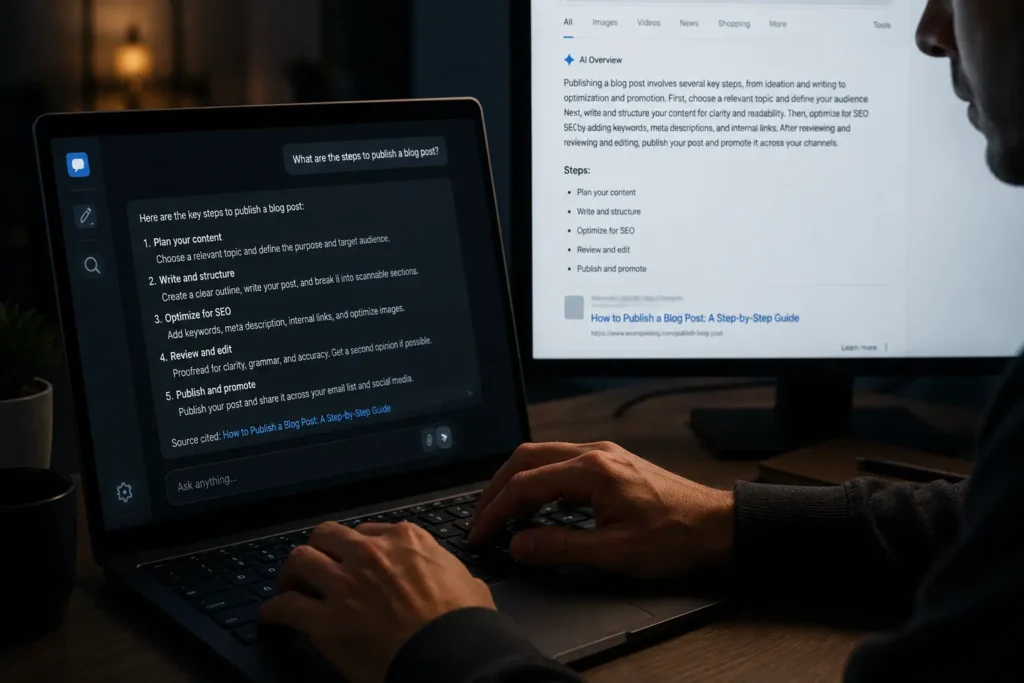
This is the section that most guides on this topic completely ignore. In 2026, your articlerelease strategy must include optimization for generative engines, not just Google.
Generative Engine Optimization (GEO) is the practice of formatting and structuring your content so AI tools like ChatGPT, Perplexity, and Gemini can extract, cite, and recommend it in their responses.
Here is a 5-point GEO checklist to add to every articlerelease:
- Write a labeled TL;DR summary at the top of your article. AI engines frequently extract summary blocks as standalone answers.
- Use direct answer sentences at the start of each major section. Short, self-contained answers are what AI engines pull as cited snippets.
- Add FAQ schema markup to any question-based subheadings in your article.
- Include NLP entities naturally throughout your content. Brand names, tool names, standards, and organizations (such as Yoast SEO, Google Search Console, WordPress, or HubSpot) signal topical authority to both Google and AI engines.
- Avoid walls of text. Use bullet lists, numbered steps, and tables wherever possible. Structured content is far more likely to be cited than dense paragraphs.
AI Overviews in Google now occupy the top of many search result pages. Structured, well-released content with clear definitions and direct answers has the highest chance of appearing inside those overviews. This means your articlerelease process is now directly connected to AI visibility, not just traditional organic rankings.
Common Mistakes to Avoid in Your Articlerelease
Even experienced content creators make these errors. Knowing them upfront saves time and traffic.
Rushing the publish: Skipping proofreading, missing internal links, or ignoring the meta description are easy mistakes that cost you rankings. Slow down the pre-publish review step.
Ignoring timing: Publishing on a Tuesday morning versus a Saturday afternoon can change early engagement significantly. Check your audience analytics before scheduling.
Skipping distribution: Many bloggers treat publication as the finish line. It is actually the starting line. Without distribution activation, even strong articles fade fast.
Inconsistent release schedule: Sporadic publishing confuses both your audience and Google’s crawl schedule. A consistent content calendar builds topical authority faster and keeps your editorial strategy on track.
Writing for algorithms only: Google and AI engines both now reward content that respects readers. Readability, sentence clarity, and logical flow directly affect your rankings and your reader retention.
Final Thoughts: Make Every Articlerelease Count
Articlerelease is no longer a simple step in your content workflow. It is a full strategy that blends editorial quality, technical SEO, smart distribution, and AI visibility optimization. When you treat it as a framework rather than a button click, every article you publish becomes a long-term traffic asset.
The writers and publishers who win in 2026 are not the ones producing the most content. They are the ones executing the most intentional releases. They plan before writing, optimize before publishing, activate immediately after, and measure consistently afterward.
If you are building a content strategy and want your articles to rank in Google, get cited by AI engines, and actually reach real readers, start applying the articlerelease framework to every piece you publish. Each article adds to your digital footprint. Each well-executed release builds your credibility, authority, and audience trust over time.
Content that disappears is content that was written but never truly released. Make sure yours is released the right way.