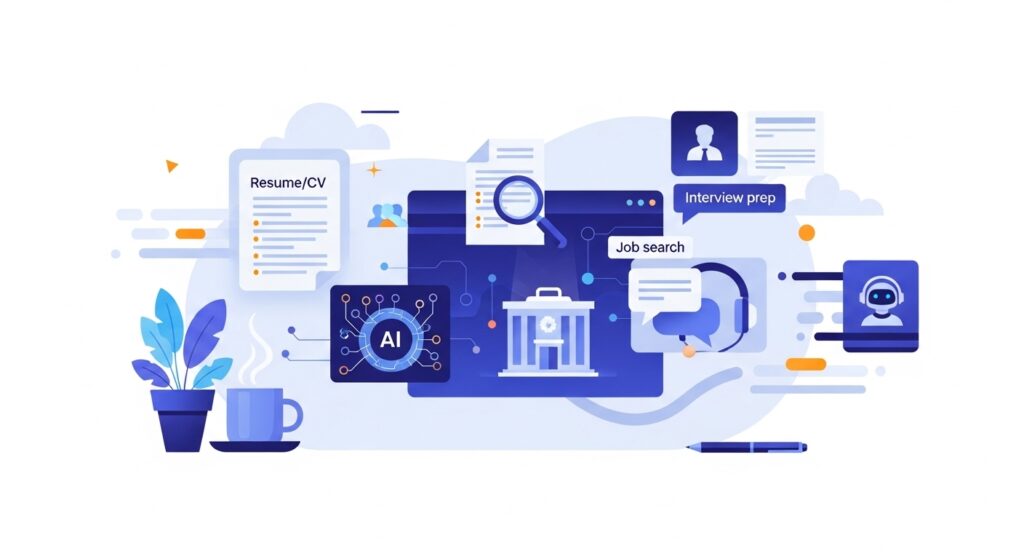
Using AI career tools is no longer just an option for job seekers; it’s becoming a necessity for staying competitive. If you feel like you’re sending resumes into a black hole or struggling to keep up with applications, AI is the advantage you’ve been missing. This guide breaks down the best tools for 2025 and shows you exactly how to use them to land your next job faster.
The modern job search is a numbers game mixed with a personalization challenge. Recruiters spend mere seconds on each resume. Application tracking systems (ATS) filter out qualified candidates before a human ever sees them. AI tools are designed to beat this system. They help you tailor your application at scale, prepare for interviews with precision, and find roles you might have missed.
What Are AI Career Tools Anyway?
AI career tools are software applications that use artificial intelligence to help you with job-seeking tasks. This includes building your resume, searching for jobs, preparing for interviews, and networking. They act as smart assistants, automating the repetitive parts of the job hunt so you can focus on making a human connection.
These tools are not a single thing. They fall into several distinct categories:
- Resume Builders: These analyze a job description and help you rewrite your resume to match its keywords and required skills.
- Job Matchers: These learn your preferences, skills, and career goals to suggest jobs that are a perfect fit, often better than you could find manually.
- Interview Simulators: These tools let you practice answering common interview questions. They then give you feedback on your answers, your speaking pace, and even your non-verbal cues.
- Outreach Assistants: These help you draft networking messages, follow-up emails, and connection requests on platforms like LinkedIn.
Think of these tools as a co-pilot for your career. You are still the pilot, making the final decisions. The AI just handles the complex navigation and repetitive checks, freeing you up to fly.
Why Should You Use AI in Your Job Search in 2025?
You should use AI in your job search to save time, improve the quality of your applications, and gain a competitive edge. AI tools can analyze thousands of data points in seconds, offering insights a human could not. This leads to more targeted applications, better interview performance, and a higher chance of getting hired.
The job market in 2025 is saturated. Some job postings receive over 200 applications within the first 24 hours. Your challenge is twofold:
- Get past the machine: You must pass the initial ATS screening.
- Impress the human: You must quickly convince a hiring manager you are the right choice.
AI tools tackle both. An AI resume scanner optimizes your resume to get a high ATS score. An AI interview coach spots your verbal tics (like using “um” too much) before a human recruiter does. This preparation makes you appear more polished and professional. It’s about working smarter, not harder.
Best AI Resume Builders and Resume Scanners
This category of tools is your first line of offense. AI resume builders help you create a document that is perfectly tailored to a specific job description. Scanners analyze your existing resume and tell you what’s missing.
How do AI resume builders work?
AI resume builders parse a job description to identify the most important keywords, skills, and qualifications. They then compare this list to your resume. The tool will suggest specific phrases, highlight missing skills, and even auto-generate bullet points in the correct format (like the STAR method) to show your impact.
The main goal is ATS optimization. Most large companies use Applicant Tracking Systems. These systems scan resumes for keywords and score them. If your score is too low, your application is automatically rejected. An AI resume builder ensures your resume has the exact language the ATS is looking for, dramatically increasing your chances of being seen by a real person.
Top AI Resume Tool 1: Teal
Teal is more than just a resume builder; it’s a complete job search tracker. Its Chrome extension lets you save jobs from any board (LinkedIn, Indeed, etc.) into a central dashboard.
- What it does: Teal’s “Resume Builder” feature lets you store a “bank” of your past accomplishments. When you apply for a job, you select the saved job description, and Teal shows you the top 5-10 keywords you need. You can then quickly tailor a new version of your resume, pulling in the most relevant accomplishments.
- Best Feature: The “Keyword Matching” tool is outstanding. It gives you a real-time match score as you edit your resume against the job description.
- Pricing: Teal offers a very generous free plan. The paid plan, Teal+, unlocks unlimited resume keywords and advanced tracking.
Top AI Resume Tool 2: Rezi
Rezi is heavily focused on AI-powered writing and formatting. It’s built to create resumes that are guaranteed to pass any ATS scan.
- What it does: You can feed Rezi a job description, and its AI writer will help you craft bullet points that match the role’s requirements. It also has a “real-time content analysis” feature that checks for 23 different criteria, including formatting, brevity, and use of strong action verbs.
- Best Feature: The AI writer is a lifesaver when you have writer’s block. It also offers “AI-generated” summary statements that sound professional.
- Pricing: Rezi has a limited free plan. Paid plans unlock more AI credits and resume templates.
Top AI Resume Tool 3: Kickresume
Kickresume combines AI writing assistance with beautiful, professional design templates. It’s a great choice for those who want a resume that is both highly optimized and visually appealing.
- What it does: Kickresume’s “AI Writer” can generate entire sections of your resume based on your job title. You can also import your LinkedIn profile to create a first draft instantly. It’s excellent for students or career switchers who may not have a lot of experience to draw from.
- Best Feature: The combination of powerful AI suggestions and a library of 35+ professional templates makes it easy to create a polished document in minutes.
- Pricing: Offers a free plan with basic templates. Premium plans unlock all designs and AI features.
Pro-Tip: Avoiding the “AI” Look on Your Resume
A common mistake is accepting all AI suggestions without review. This can make your resume sound robotic or generic.
- Always edit for voice: Read the AI-generated bullet points out loud. Do they sound like you? Change the wording to match your personal tone.
- Verify impact: AI is good at describing a task, but bad at quantifying your specific impact. Always add your own numbers.
- AI: “Responsible for managing social media accounts.”
- You (Edited): “Grew social media accounts by 45% (to 100k followers) in 6 months by launching three new video campaigns.”
- Check for errors: AI can “hallucinate” or make up details. Double-check everything it writes for accuracy.
Top AI Job Matching and Search Platforms
You can stop endlessly scrolling through irrelevant job postings. AI job matching platforms learn what you actually want in a role—beyond just a job title—to find the perfect fit.
Are these platforms better than traditional job boards?
Yes, for targeted searches. Traditional boards like Indeed or LinkedIn rely heavily on your keyword inputs. AI job matchers use a “recommendation engine,” much like Netflix. They analyze your skills, experience, career goals, and even the “culture” of companies you like. They then find and rank opportunities for you.
These platforms are excellent at finding “hidden gem” jobs. These are roles you might have missed because they had an unusual title or were at a company you hadn’t heard of. They broaden your search while also making it more relevant.
Top AI Job Matcher 1: LoopCV
LoopCV takes job matching a step further by automating the application process itself. It’s a powerful tool for high-volume, targeted job searches.
- What it does: You set your job search criteria (role, location, seniority). LoopCV then finds matching jobs from hundreds of sources. You upload your resume and cover letter, and the platform can automatically apply to these jobs on your behalf.
- Best Feature: The automation is its core strength. It’s a huge time-saver. We broke down its specific features in our LoopCV review.
- Pricing: LoopCV operates on a subscription model, with different tiers based on the number of automated applications you want to send per day.
Top AI Job Matcher 2: Jobscan
While known as a resume tool, Jobscan’s “Job Matcher” feature is a powerful search tool. It finds jobs based on how well your resume already matches them.
- What it does: You upload your resume. Jobscan analyzes it and then scours major job boards for roles that are a high-percentage match. This reverses the normal process. Instead of tailoring your resume to a job, you find jobs that are already tailored to your resume.
- Best Feature: The “Match Rate” report. It shows you exactly why a job is a good fit and highlights any small tweaks you could make to become a perfect candidate.
- Pricing: Jobscan offers a few free scans. A paid subscription is needed for continuous scanning and advanced features.
Top AI Job Matcher 3: Huntr
Huntr is a visual job search tracker (like a Trello board) with AI features built in. It helps you manage your pipeline so no opportunity falls through the cracks.
- What it does: You save jobs to your Huntr board. The tool auto-fills all the job details (company, salary, description). It then tracks your progress for each application, from “Applied” to “Interviewing” to “Offer.” Its AI helps find contact information and suggests follow-up reminders.
- Best Feature: The organization. Seeing your entire job search visually in one place reduces stress and helps you identify where you are in the process with dozens of companies.
- Pricing: A free plan is available for managing a limited number of jobs. The paid plan offers unlimited tracking.
Must-Have AI Interview Prep Tools
The interview is where human connection matters most, but AI can give you a serious edge in preparation. AI interview tools act as a private coach, letting you practice in a safe space until you feel completely confident.
How do AI interview coaches analyze responses?
These tools use AI to analyze several aspects of your performance. They transcribe your words to check your answer against proven structures, like the STAR method. They also use speech analysis to monitor your pace, use of filler words (“like,” “um”), and overall tone. Some advanced tools even use your camera to analyze body language and eye contact.
After a practice session, you get a detailed report. For example: “Your answer for ‘Tell me about a time you failed’ was strong, but you used ‘like’ 8 times and spoke too quickly. Try to pause and add a specific metric about what you learned.” This level of detailed, instant feedback is impossible to get elsewhere.
Top AI Interview Tool 1: Big Interview
Big Interview is one of the most comprehensive interview training systems available. It was developed by a professional interview coach and uses AI to power its feedback.
- What it does: You can choose from thousands of practice questions (general, behavioral, or industry-specific). You record your answer, and the AI “Answer Rater” gives you a score and detailed feedback on everything from your answer content to your delivery.
- Best Feature: The “Answer Builder” feature. It walks you through crafting perfect STAR-method answers to tough behavioral questions before you even start practicing.
- Pricing: This is a premium tool, often sold to universities, but individual subscriptions are available.
Top AI Interview Tool 2: VMock
VMock is an AI-powered platform that aims to be an all-in-one career assistant. Its “Smart Interview” feature is a standout.
- What it does: VMock provides a curated set of questions based on your specific career goals. It gives you instant, AI-generated feedback on your communication skills, body language, and the content of your answers. It’s fast and easy to use.
- Best Feature: The holistic feedback. It connects your interview performance back to your resume, suggesting ways to talk about your experience more effectively.
- Pricing: VMock is primarily sold through partner universities, but they are expanding access.
Top AI Interview Tool 3: Google’s Interview Warmup
Interview Warmup is a completely free tool from Google. It’s simple, accessible, and surprisingly powerful for a free product.
- What it does: You choose your field (like “Data Analytics” or “Project Management”). The tool asks you relevant questions. It transcribes your answers in real-time. Afterward, it doesn’t “score” you, but it points out insights, such as which job-related terms you used, which skills you talked about, and your most-used words.
- Best Feature: It’s free and browser-based. It’s the perfect tool for a quick practice session to identify your “verbal tics” and ensure you’re talking about the right topics.
- Pricing: 100% free.
How to Use AI for Professional Networking and Outreach
AI can help you break the ice and build professional relationships. It’s particularly useful for introverts or anyone who struggles with what to say in a networking context.
Can AI help with LinkedIn outreach?
Yes, AI is excellent at drafting concise, professional networking messages. Many AI writing assistants (like Jasper or ChatGPT) can be prompted to write a connection request or a follow-up email.
The key is providing a specific prompt.
- Bad Prompt: “Write a LinkedIn message.”
- Good Prompt: “Write a 3-sentence LinkedIn connection request to a ‘Marketing Director’ at [Company]. My goal is to ask for a 15-minute coffee chat about their experience in the CPG industry. My tone should be professional, respectful, and curious.”
Writing the Perfect Follow-Up
Following up after an application or interview is critical. AI can help you draft a message that is polite, professional, and clear.
- Example Use: Use an AI tool to summarize your interview conversation. Then, ask it to draft a “Thank You” email that mentions one or two specific points you discussed.
- Internal Link: AI can draft a strong, professional cold message. You still need the right template. (See our guide on message to hiring manager templates for examples of what to send).
What Are the Risks and Pitfalls of Using AI Career Tools?
Using these tools comes with risks. You must be aware of data privacy, the potential for bias, and the danger of sounding generic. Being a smart user means knowing the pitfalls and actively avoiding them.
The “Generic” Trap: Why You Must Always Edit AI Output
The biggest risk is over-reliance. If you copy and paste an AI-generated resume summary or cover letter, you will sound like every other candidate doing the same thing. Recruiters can spot this “AI voice” from a mile away. It lacks personality and specific, human experience.
Your Experience: I once tested an AI cover letter writer. It produced a technically perfect letter. But it was dull. It had no story, no passion. It wouldn’t have impressed anyone. You must always add your personal stories, your “why,” and your unique voice to the AI-generated draft.
Data Privacy: Where Does Your Resume Data Go?
When you upload your resume to a free AI tool, you are giving it your data. This data—your work history, your skills, your contact info—is valuable. Some platforms may use this data to train their models or, in worse cases, sell it to third-party recruiters.
- How to protect yourself:
- Read the privacy policy. See how they use your data.
- Use reputable, well-known tools.
- Consider creating a “public” version of your resume with a generic email and phone number (like a Google Voice number) just for these tools.
Bias in AI: How Tools Can Filter Out Good Candidates
AI models are trained on historical data. If that data contains past hiring biases (e.g., favoring candidates from certain schools or backgrounds), the AI can learn and perpetuate those biases. This is a new front for hr risk management. While companies are working to fix this, no AI is perfect.
The tool might incorrectly flag your non-traditional career path as a weakness. It might downgrade your resume because you used different phrasing for a skill. Always treat the AI’s “score” as a suggestion, not a final verdict.
What’s New in 2025? The Future of AI in Career Growth
AI in the career space is moving incredibly fast. The tools of today are just the beginning. We’re moving from simple “assistants” to fully autonomous “agents” and “coaches.”
AI as a Career Agent
The next generation of tools won’t just suggest jobs; they will actively manage your career. You will tell your AI agent your long-term goals (e.g., “I want to be a ‘Director of Product’ in 5 years”). The AI will then:
- Identify the skill gaps you have.
- Recommend specific online courses or projects to fill those gaps.
- Proactively search for “stepping stone” jobs that move you in the right direction.
- Network on your behalf to connect with people who can help you.
AI for Upskilling and Skill Mapping
AI is becoming a key part of learning platforms. Tools like SkillUp Coalition (a non-profit) are using AI to help workers displaced by technology find new career paths. The AI maps their existing skills to in-demand jobs and creates a personalized training roadmap. This is a shift from “job finding” to “career building.”
Deeper Integration with Major Platforms
Expect AI features to become standard in the tools you already use.
- LinkedIn: Is already using AI to suggest message drafts, write profile summaries, and recommend connections.
- Google: Is integrating AI directly into Search, making job discovery more conversational.
- Microsoft: Is building AI co-pilots into Word (for resume writing) and Teams (for interview feedback).
How Do I Choose the Right AI Tool for Me?
You don’t need every tool. The right choice depends on your specific needs, your budget, and your career stage. A student needs a different tool than a senior executive.
Start by identifying your biggest “pain point.”
- “My resume gets no responses.” -> Start with an AI Resume Builder (like Teal or Jobscan).
- “I hate searching for jobs.” -> Start with an AI Job Matcher (like LoopCV).
- “I get nervous in interviews.” -> Start with an AI Interview Coach (like Big Interview).
Table: Free vs. Paid AI Career Tools
| Feature | Free Tools | Paid Tools |
| Resume Scans | Usually 3-5 free scans. Basic keyword matching. | Unlimited scans. Advanced keyword analysis, AI writing. |
| Job Tracking | Limited (e.g., track up to 10 jobs). | Unlimited job tracking, email templates, follow-up reminders. |
| Interview Prep | Basic questions, transcription only (e.g., Google). | Advanced feedback (tone, body language), custom questions. |
| Best For | Quick checks, casual job seekers, students. | Active job seekers, career switchers, professionals. |
What if I’m a student?
Focus on tools that help you build from scratch. A tool like Kickresume is great because its AI writer and beautiful templates can make a limited work history look professional and strong. Google’s Interview Warmup is a perfect free tool for practicing for those first few internships.
What if I’m a career switcher?
Your main challenge is translation. You need to show how your skills from your old career (e.g., “teaching”) apply to your new one (e.g., “corporate training”). Use an AI resume builder like Jobscan to find the right keywords to bridge that gap. The AI can help you rephrase your accomplishments in the language of your new industry.
What if I’m an executive?
Your search is about networking and branding, not volume. You won’t be using LoopCV to apply for 100 jobs. Instead, use AI writing assistants to draft high-level thought leadership posts for LinkedIn. Use AI to research companies and their executive teams to personalize your outreach.
These tools are powerful, but they are supplements, not replacements, for foundational career planning. They can’t replace the value of a good mentor or traditional Career assessment methods that help you understand your core values.
Final Verdict: Are AI Career Tools Worth It?
Yes, 1,000 times yes. AI career tools are absolutely worth it. They level the playing field by giving you access to the same technology that companies use to filter you. When used correctly, they are the most powerful co-pilot you can have for your job search.
The key is to use them as a co-pilot, not an autopilot.
- Use AI to beat the ATS scan.
- Use your brain to impress the human.
- Use AI to handle the 80% of repetitive work (finding jobs, filling forms).
- Use your time to do the 20% that matters (networking, deep research, personalizing your “why”).
The 2025 job search is a partnership between you and the machine. Embrace the tools, learn their strengths, and understand their weaknesses. This is how you get hired.