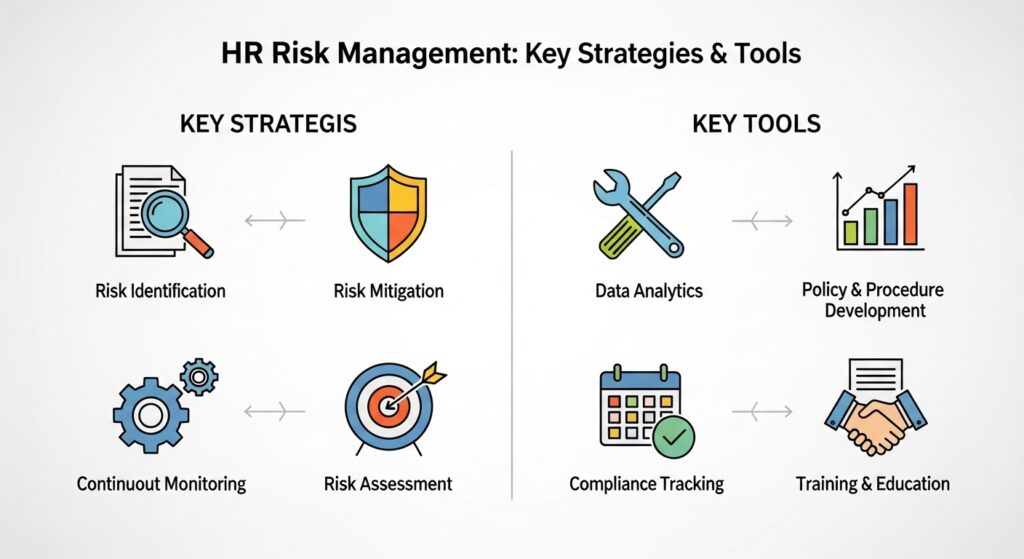
Effective HR risk management is the art of protecting your organization from its most valuable and volatile asset: its people. Many business leaders think HR is just about hiring, payroll, and planning the company picnic. In reality, HR’s most critical function is identifying and neutralizing the “people problems” that can lead to lawsuits, PR nightmares, and operational collapse.
Ignoring these risks is not an option. From a single poorly-worded job description to a toxic culture that brews for years, the liabilities are massive. A proactive risk management strategy is what separates a resilient business from a future case study. This guide provides the complete framework, from identifying the seven key types of HR risk to implementing the tools and policies that protect your team and your bottom line.
What Is HR Risk Management?
HR risk management is the systematic process of identifying, assessing, and mitigating risks that arise from your workforce and HR practices. It’s about proactively finding potential problems—like compliance gaps, safety hazards, or toxic managers—before they turn into costly lawsuits, high turnover, or brand damage.
This isn’t just about playing defense. It’s a core business strategy. It’s the formal version of “an ounce of prevention is worth a pound of cure.” By understanding where your people-related vulnerabilities are, you can build a more stable, ethical, and productive workplace.
Why Is Proactive HR Risk Management So Important?
Proactive HR risk management is important because it saves money, protects your brand’s reputation, and builds a more stable, productive workforce. It’s the difference between fixing a small leak and rebuilding your house after a flood. A single lawsuit or a wave of bad press can be devastating.
The benefits of taking this seriously are clear and measurable:
- Financial Savings: The cost of an average employment lawsuit can run into six figures, not including settlement costs. Add to that the high cost of employee turnover—often cited as 1.5-2x an employee’s salary—and prevention becomes a clear financial win.
- Brand and Reputation Protection: In the age of Glassdoor and social media, a toxic workplace culture is impossible to hide. A bad reputation scares away top talent, repels customers, and makes every aspect of business harder.
- Operational Stability: High turnover, low morale, or internal conflicts don’t just feel bad; they kill productivity. A stable, safe, and fair environment allows people to focus on their work, leading to better business continuity and output.
- Compliance and Legal Security: This is the bare minimum. Staying on top of the complex web of labor laws (federal, state, and local) keeps you out of legal trouble and avoids massive fines and penalties.
What Are the 7 Key Types of HR Risks?
The 7 key types of HR risks are:
(1) Legal and Compliance,
(2) Health and Safety,
(3) Hiring and Talent,
(4) Data Privacy and Cybersecurity,
(5) Workplace Culture and Employee Relations,
(6) Performance and Productivity, and
(7) Retention and Turnover. Each one can cause significant financial and reputational harm.
Understanding these categories is the first step to identifying them in your own organization.
1. Legal and Compliance Risks
This is the risk of violating local, state, or federal employment laws. It’s the most obvious and expensive risk, including everything from discrimination and harassment claims to improper wage calculations.
- Common Examples:
- Misclassification: Wrongly labeling employees as “independent contractors” to avoid paying benefits and taxes.
- Wage and Hour: Failing to pay overtime correctly, not providing required breaks, or docking pay improperly.
- Discrimination: Making hiring, promotion, or firing decisions based on a protected class (race, gender, age, religion, disability, etc.).
- Harassment: Allowing a hostile work environment, most notably sexual harassment.
- Wrongful Termination: Firing an employee in violation of a contract or public policy (e.g., as retaliation for reporting a safety violation).
2. Health and Safety Risks
This risk involves any threat to the physical or psychological well-being of your employees. It goes far beyond construction sites or factories. In the modern workplace, this includes mental health just as much as physical safety.
- Common Examples:
- Physical Hazards: Workplace accidents, slips and falls, or injuries from unsafe equipment.
- Poor Ergonomics: Failing to provide proper chairs, desks, or monitors, leading to long-term repetitive stress injuries (a huge issue with remote work).
- Workplace Violence: A lack of security or failure to act on threats from an employee or outside party.
- Burnout and Stress: A culture of overwork, poor management, or lack of support that leads to mental health crises and exhaustion.
3. Hiring and Talent Risks
This is the risk that comes from your recruitment process. A bad hiring process can saddle you with underperforming employees, expose you to discrimination lawsuits, or simply leave you unable to fill critical roles.
- Common Examples:
- Unconscious Bias: Managers favoring candidates who “look like them” or come from the same school, leading to a non-diverse, weaker team.
- Poor Candidate Experience: A slow, confusing, or disrespectful hiring process that causes top candidates to drop out and accept offers elsewhere.
- “Bad Hires”: Hiring someone who is a poor fit for the role or culture. [Data from the U.S. Department of Labor] suggests the cost of a bad hire can reach 30% of their first-year earnings.
- Talent Shortages: Your compensation, brand, or location makes it impossible to attract people with the skills you need to grow.
4. Data Privacy and Cybersecurity Risks
HR departments hold the “crown jewels” of employee data: Social Security numbers, bank details, home addresses, and private health information. This risk is the failure to protect that sensitive data from internal or external threats.
- Common Examples:
- External Breach: A hacker gains access to your HRIS (Human Resources Information System) and steals employee PII (Personally Identifiable Information).
- Internal Negligence: An HR employee leaves a laptop with unencrypted files at a coffee shop or accidentally emails a payroll report to the wrong person.
- Phishing Attacks: An employee clicks a malicious link, giving bad actors access to the network. This is an HR training issue, not just an IT one.
- Compliance Violations: Failing to comply with data privacy laws like GDPR or CCPA, leading to massive fines.
5. Workplace Culture and Employee Relations Risks
This is the “silent killer” of organizations. It’s the risk of a toxic, unsupportive, or unethical environment. It directly causes low morale, kills collaboration, and is a primary driver of high turnover.
- Common Examples:
- Toxic “Superstars”: A high-performing salesperson who bullies their colleagues. Management is afraid to act, and the entire team’s morale collapses.
- Lack of Psychological Safety: Employees are afraid to speak up, admit mistakes, or suggest new ideas for fear of being shamed or punished.
- Poor Management: Untrained managers who micromanage, play favorites, or fail to communicate, causing disengagement.
- Internal Conflict: Unresolved disputes between teams or individuals that fester and reduce company-wide productivity.
6. Performance and Productivity Risks
This is the risk that your workforce is not performing at the level required to meet business goals. It’s not just about “lazy” employees; it’s about a systemic failure to manage, train, and motivate your team.
- Common Examples:
- Unclear Expectations: Employees don’t know what “success” looks like. Goals are vague, and feedback is non-existent.
- Skills Gaps: The business needs change, but the employees aren’t trained on the new systems or processes, leading to widespread inefficiency.
- Poor Onboarding: New hires are “thrown in the deep end” with no structured training, leading to a long and frustrating ramp-up time.
- Disengagement: Employees are bored, burned out, or feel disconnected from the company’s mission, so they do the bare minimum to get by.
7. Retention and Turnover Risks
This is the risk of losing your best employees. High turnover is incredibly expensive and disruptive. It’s often a symptom of other risks on this list, like a toxic culture or poor compensation.
- Common Examples:
- Key-Person Dependency: Your entire sales process relies on one person. If they leave, that revenue stream is in jeopardy.
- Non-Competitive Compensation: Your pay and benefits are below market rate, and your top performers are being actively poached by competitors.
- No Career Path: Ambitious employees see no opportunity for growth, so they leave to get a promotion elsewhere.
- “Retirement Tsunami”: A large portion of your experienced workforce is nearing retirement age, and there is no plan to transfer their knowledge.
What Is the 5-Step HR Risk Assessment Framework?
An HR risk assessment framework is a five-step cycle to systematically manage your “people risks.” The steps are: (1) Identify all potential risks, (2) Analyze each risk by its likelihood and impact, (3) Prioritize the risks to focus your resources, (4) Respond with a mitigation plan, and (5) Monitor the plan and review it regularly.
This framework moves you from a reactive “fire-fighting” mode to a proactive, strategic one.
Step 1: Identify the Risks
You can’t fix a problem you don’t know you have. This step is about brainstorming every possible “people problem” in your organization.
- How to do it:
- Review Documentation: Read your employee handbook, past lawsuits, and safety incident reports.
- Analyze Data: Look at your turnover stats, exit interview feedback, and absenteeism rates.
- Conduct Surveys: Use anonymous pulse surveys to ask employees about culture, management, and safety.
- Run Audits: Do a self-audit of your payroll records and I-9 forms for compliance gaps.
- Talk to People: Interview managers and frontline employees. They know where the real problems are.
Step 2: Analyze the Risks
Once you have your list, you need to figure out which ones really matter. For each risk, you analyze two things: its likelihood (how likely is this to happen?) and its impact (how bad will it be if it does?).
You can plot this on a simple “risk matrix”:
- High-Likelihood, High-Impact: (e.g., misclassifying all your contractors) -> CRITICAL.
- Low-Likelihood, High-Impact: (e.g., a workplace violence incident) -> PREPARE.
- High-Likelihood, Low-Impact: (e.g., a confusing onboarding form) -> MANAGE.
- Low-Likelihood, Low-Impact: (e.g., running out of coffee) -> MONITOR.
Step 3: Prioritize the Risks
You cannot fix everything at once. Prioritization means ranking your risks based on the analysis from Step 2. Your focus should always be on the “Critical” (High/High) risks first.
A high-impact, high-likelihood risk—like a clear pattern of harassment from a manager—demands an immediate response. A low-impact, low-likelihood risk—like an outdated policy on personal desk decorations—can wait. This step is about focusing your limited time and budget where they matter most.
Step 4: Respond and Mitigate
Now you create a plan. For every high-priority risk, you choose a response. There are four main strategies (sometimes called the “4 T’s”):
- Treat (or Reduce): This is the most common. You implement a control to reduce the risk’s likelihood or impact.
- Risk: Harassment. Response: Implement mandatory annual anti-harassment training.
- Transfer (or Share): You transfer the financial impact of the risk to a third party.
- Risk: A costly wrongful termination lawsuit. Response: Purchase Employment Practices Liability Insurance (EPLI).
- Terminate (or Avoid): You stop the high-risk activity entirely.
- Risk: Misclassification lawsuits from contractors. Response: Stop using contractors for that role and hire full-time employees.
- Tolerate (or Accept): If the risk is low-impact and the cost to fix it is too high, you may choose to just accept it.
- Risk: A small, stable amount of seasonal turnover. Response: Accept it as a cost of doing business.
Step 5: Monitor and Review
HR risk management is not a “set it and forget it” project. It’s an ongoing cycle. You must constantly monitor your controls and review the plan.
- Monitor: Are people actually taking the training? Are managers actually following the new hiring guide? Use your HRIS and LMS to track compliance.
- Review: At least once a year, or whenever a major business change happens (like a merger or a shift to remote work), you must review your entire risk assessment. New laws are passed. New technologies emerge. Your risks are constantly changing, and so must your plan.
What Tools & Technologies Support HR Risk Management?
The right technology can make risk management much easier. Key tools include HRIS platforms to centralize data, Learning Management Systems (LMS) to track compliance training, and specialized platforms for pulse surveys and anonymous reporting.
Here are the essential tools for a modern HR risk stack:
- HRIS (Human Resources Information System): This is your command center (e.g., Workday, BambooHR, Rippling). It’s the single source of truth for all employee data, from hire dates to payroll to performance reviews. You can’t manage risk without clean data.
- LMS (Learning Management System): An LMS allows you to assign, deliver, and—most importantly—track mandatory training. If you are ever sued, your first line of defense is proving you trained your employees on the policy they violated.
- ATS (Applicant Tracking System): A good ATS standardizes your hiring process. It ensures every candidate goes through the same steps, which reduces bias and helps you create a defensible, fair process.
- Pulse Survey & Engagement Tools: Platforms like Culture Amp or Peakon allow you to send short, frequent, anonymous surveys to “pulse” the health of your culture. This gives you real-time data on management issues or burnout before they lead to turnover.
- Anonymous Reporting Hotlines: You must have a channel for employees to report serious issues (like theft, harassment, or safety violations) without fear of retaliation. This can be a simple third-party web form or phone line.
- Payroll & Compliance Software: These tools automate wage and hour calculations, tax filings, and benefits administration, significantly reducing the risk of a costly compliance error.
What Is the Role of AI in HR Risk Management?
AI is a powerful new tool for HR risk management, but it’s also a new source of risk. AI can be used to analyze data to predict turnover, audit job descriptions for biased language, and monitor communications for compliance breaches.
The Benefits (The “Pros”):
- Predictive Analytics: AI can analyze thousands of data points (pay, time-off, tenure, manager) to predict which high-performers are at risk of leaving.
- Bias Auditing: AI tools can scan job descriptions, performance reviews, and even internal messages to hiring managers to flag biased or non-inclusive language.
- Automation: Using automation tools for tasks like candidate sourcing can standardize the top of the funnel. Some platforms, as seen in this LoopCV review, can manage applications, though this requires careful oversight.
The Risks (The “Cons”):
- Automated Bias: This is the biggest risk. If you train an AI model on your last 10 years of “successful” hires, and those hires were all white men from a specific school, the AI will learn that bias. It will then automatically reject qualified candidates who don’t fit that old pattern.
- “Black Box” Problem: Many AI tools are a “black box,” meaning you don’t know why they made a certain decision. This is a legal nightmare if a candidate sues and you can’t explain why your AI rejected them.
- New Regulations: Cities and states are already passing laws (like NYC’s Local Law 144) that require audits of automated hiring tools. Using these AI career tools without understanding the law is a massive new compliance risk.
How Do You Create an HR Risk Management Policy?
An HR risk management policy is not a single document. It’s a collection of clear, accessible policies, starting with a strong employee handbook. It must also include clear reporting procedures and a plan for training your managers.
Here is a 5-step checklist to build your policy:
- Build a Strong Employee Handbook: This is your foundation. It must clearly outline policies on everything: code of conduct, anti-harassment, anti-discrimination, data security, safety, and leave. It should be written in simple language, not legalese. All employees must sign an acknowledgment that they have read and understood it.
- Establish Clear Reporting Channels: What should an employee do if they are harassed? What if their manager is the harasser? You need a clear, confidential reporting process that gives employees multiple options (e.g., HR, an anonymous hotline, a designated executive).
- Train Your Managers: Your managers are your first line of defense and your biggest liability. They must be trained on how to spot risks, handle complaints, conduct interviews legally, and manage performance fairly.
- Create an Investigation Procedure: When a complaint is filed, you must have a standardized, fair, and fast process for investigating it. This process must be documented to protect the company legally.
- Get Insurance: Purchase Employment Practices Liability Insurance (EPLI). This is the “Transfer” strategy. It’s your financial backstop if, despite all your best efforts, you still get sued.
Final Verdict
HR risk management is not about creating a fear-based, restrictive workplace. It’s the exact opposite.
It’s about building a strong, fair, and stable foundation so your business can thrive. By proactively managing your “people problems,” you create an environment of trust and psychological safety. This allows your employees to do their best work without fear, protects your brand’s reputation in the market, and saves your company from predictable—and preventable—disasters. It’s not a one-time project; it’s the ongoing commitment to building a great, and safe, place to work. It’s a key pillar of a company’s overall Risk management strategy.